-
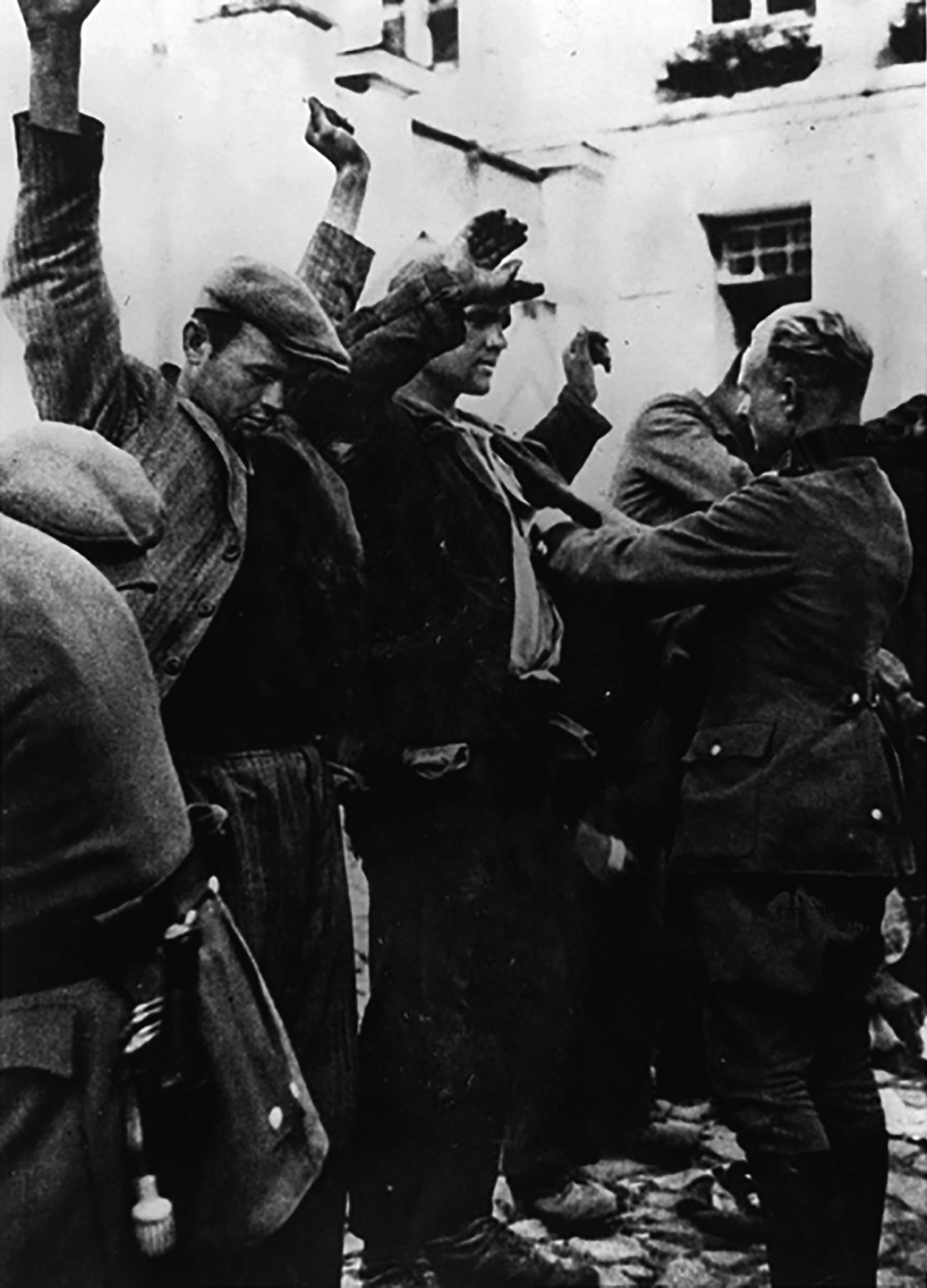
PLTerror powszechny
- ENUniversal terror
IN THE SHARED
LAND
Pre-war Poland was home to many nationalities. All of its citizens were equal in the eyes of the law and enjoyed the same rights as citizens. The fact that Poles had lived for centuries in peace with the Jews only further condemned them with the Germans.
Polish citizens by denomination (1931)
Polish citizens by native language (1931)
Polish citizens by denomination and native language (1931)
Source: The Second Census, dated 9 December 1931.
Living premises and households. Population,
Warsaw 1938.
LESS THEN ENOUGH
The discriminative nature of the food rations shows the racist attitudes of the Germans towards the so-called “non-Aryan” population of occupied Poland. For Poles, these amounts were only enough to cover 30% of their necessary daily food intake, for Jews, this barely amounted to 10%.
The calorific value of food rations
in occupied Warsaw in 1941
Source: T. Szarota, Okupowanej Warszawy dzień powszedni
[Day-to-day in Occupied Warsaw], Warszawa 2010, p. 180.
POLES AND JEWS – VICTIMS OF THE THIRD REICH
More than 5.5 million citizens of the Second Polish Republic were killed during the German occupation. Nearly 3 million of 3.5 million Jews lost their lives in the Holocaust. Poles were also treated as “sub-humans”; the German terror affected almost every Polish family.
Estimated number of victims in regions occupied by the Third Reich
Source: Polska 1939–1945. Straty osobowe i ofiary represji
pod dwiema okupacjami [Poland 1939–1945. Personnel losses and victims of repression under two occupations], ed. M. Materski, T. Szarota, Warszawa 2009, p. 9.
LOST GENERATIONS
World War II was a demographic catastrophe for Poland. Pre-war forecasts had predicted Poland‘s population
to surpass 38 mln people in 1946; after the war, barely 24 mln people still lived in the country the borders of which had been drastically altered.
Forecasted vs. actual population of Poland on 1 January 1946
Source: Polska 1939–1945. Straty osobowe i ofiary represji pod dwiema okupacjami [Poland 1939–1945. Personnel losses and victims of repression
under two occupations], ed. M. Materski, T. Szarota, Warszawa 2009, p. 40.